
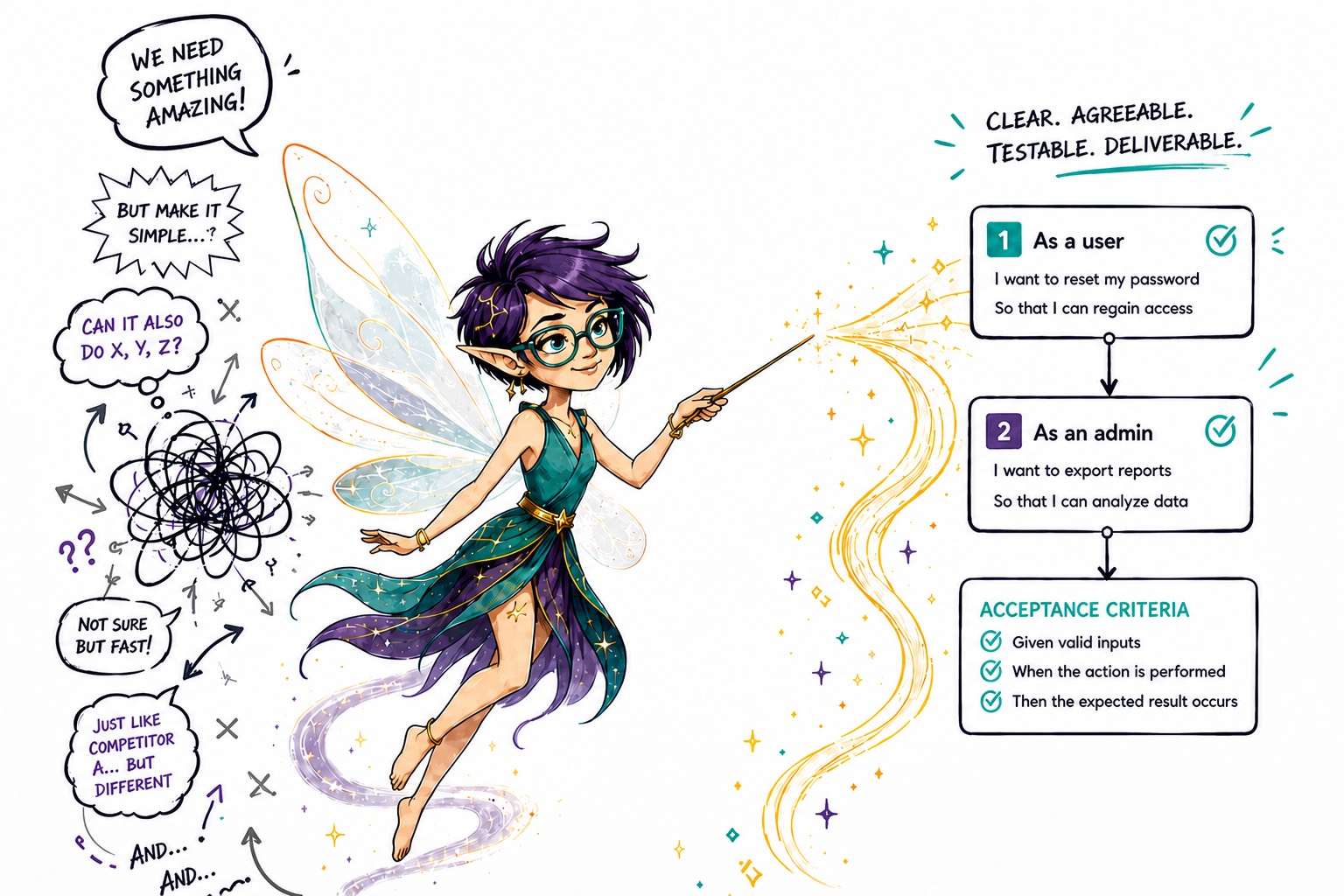
The difference does not surface in the meeting. It surfaces in testing, in a change request, or after go-live.
The Requirements Engineering Toolkit exists to close that gap earlier. It is a set of guided workflows and ready-made materials that take a request from “we need something like this” to requirements a developer can build and a tester can prove.
What it does
The toolkit follows the natural life of a requirement, one step at a time.
It helps you start. Before a single requirement is written, it turns a thin request into a workshop plan: who to talk to, what to ask them, which words need a shared definition, and what is still unknown.
It drafts the requirements. Understanding becomes wording — testable requirements, user stories, Given/When/Then acceptance criteria, and non-functional requirements with real numbers instead of adjectives. Common features such as uploads, approvals, notifications and access control come with their questions already worked out, so the same detail is not rediscovered on every project.
It reviews what exists. Any requirement, story or set of acceptance criteria can be audited for ambiguity, gaps and risk. Findings come back rated by severity, with the open questions left explicitly for a person to answer.
It writes the test cases. Acceptance criteria are turned into concrete test cases, and a traceability matrix links business goal → requirement → story → test, so a coverage hole is visible instead of assumed away.
It draws the diagrams. Context diagrams, use-case overviews, state machines, sequence diagrams and traceability graphs, generated for your system and ready to paste into a specification.
What the difference looks like
Before:
The system should let users upload documents quickly and securely, and notify the right people when something happens.
After:
The system shall allow authenticated customers to upload PDF files up to 20 MB. Each file shall be virus-scanned before it becomes available and be visible only to the customer and reviewers in the owning department. When an upload completes, the system shall notify the assigned reviewer within 1 minute.
The second version is longer, and that is the point. Every added word removes a decision that would otherwise be made — differently — by a developer, a tester and a stakeholder, each on their own, weeks later.
Who it is for
Business analysts get the questions to ask before committing to a solution, and wording that survives the handover to IT without a translation round.
Requirements engineers get a repeatable method, a quality gate before development starts, and traceability that holds up in a review.
Developers get requirements that answer the questions they would otherwise have to guess at: which roles, which limits, which error cases, which events.
What else is inside
Beyond the guided workflows, the toolkit ships more than forty stand-alone pieces: checklists for requirement, story and non-functional quality, copy-paste prompts, reusable requirement patterns for recurring features, fill-in templates for glossaries, stakeholder maps, decision records and risk registers, plus worked before/after examples showing a full run from first workshop to finished test cases.
It is free, open source, and written in plain Markdown, so anything in it can be copied into your own wiki, repository or template and adapted to your domain.
One principle runs through all of it: the toolkit does the drafting and the checking, and a person stays accountable for the final call.
👉 See what is inside and how to get it ⭐ Go straight to the repository on GitHub